Cruising

River Dreaming

by Christine Salins on November 27, 2008

Published in Cruise World, Autumn 2008.

Travelling the great rivers of Europe is like opening a treasure chest. Each time you discover something exquisite, something even more beautiful catches your eye.

From medieval towns with cobbled streets and half-timbered houses, to hillsides lined with vineyards and castles, there is fairytale scenery at every turn. Experiencing it from a small cruise ship allows you to enjoy the comforts of a five-star hotel without having to unpack your bags at each destination.

From beautifully preserved Rothenburg to Cologne with its magnificent cathedral and the colourful canals of Amsterdam, Europe is a treat for anyone interested in history, architecture or just simply beautiful scenery.

Trafalgar Uniworld’s European Serenade, a 13-day cruise from Vienna to Amsterdam that can also be done in reverse, takes in three spectacular rivers: the Danube, Main and Rhine. Also included is the Main-Danube Canal, a feat of modern engineering. It’s fascinating to see how the ship negotiates the narrow locks.

Romantics love the Rhine, especially the section around Rüdesheim where the scenery is so spectacular it has World Heritage listing. Narrow and once quite treacherous – hence the legend of the Lorelei, about a siren luring sailors to their death – this busy working river is little challenge for the Grand River Empress (Countess???) and the Grand River Duchess.

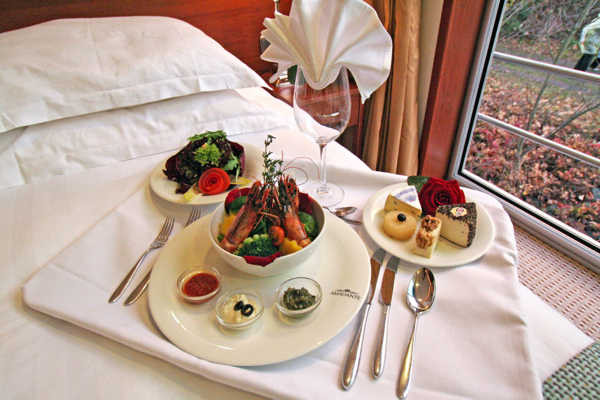
So gentle do these long, sleek vessels cruise that you sleep like a baby, lulled along by inviting beds and down-filled pillows. All rooms have an outside window, private bathrooms stocked with aromatherapy products, flat-screen televisions and a sitting area.

The food – a blend of classic and contemporary European cuisine – is outstanding, with complimentary fine wines at dinner. Cappuccinos and lattes are available 24 hours a day, while the Captain’s welcome and farewell dinner are highlights.

One of 26 European river cruise itineraries offered by Traflagar Uniworld in 2008, the European Serenade package includes 11 complimentary shore excursions led by English-speaking local guides. State-of-the-art audio headsets are provided so that you can wander off for a closer view of some architectural gem or gorgeous shop window while still listening to every word the guide has to say.

Optional excursions include a classical music concert in Vienna, the picturesque Dutch windmill village of Zaanse Schans, and a superb dinner at Rüdesheim Schloss.

Perhaps the biggest surprise of the cruise is Siegfried’s Museum in Rüdesheim, with its amazing mechanical musical instruments. Regensburg is an unspoiled gem that richly deserves its World Heritage listing. And few could fail to be impressed by Rothenburg, Germany’s best preserved medieval town.

With a maximum of 132 passengers, Trafalgar Uniworld’s boutique cruise ships have a friendly intimacy but are not so small that you are in each other’s laps. Service is attentive and personal.

Regardless of how fit you are, walking in Europe can be tiring – all those cobbled streets are hard on the legs. It’s great knowing that you can retreat to the sanctuary of your floating hotel and put your feet up while travelling to the next destination.

Fact file:

For more information about Trafalgar Uniworld’s selection of five-star European river cruises, visit www.trafalgar.net.au/RiverCruise or your local travel agent.

© Christine Salins

{ 0 comments }

Danube’s Markets Cast Their Spell

by Christine Salins on August 17, 2008

Published in The Sunday Telegraph, August 17, 2008.

Nuremberg has Europe’s oldest and largest Christmas market but there’s a romantic, more personal one at the Thurn and Taxis Palace in Regensburg. I say that with some authority, having sailed the Danube from Nuremberg to Budapest on a Christmas Time Cruise, wallowing in one or two markets each day.

Some people, myself included, could never have too many markets, although I have to admit that by the end of the trip I was whipping through them at a cracking pace. Others might tire quickly of the dolls, angels and knick-knacks, even if they’re happy to soak up the copious cups of Glűhwein.

The beauty of river-cruising is that you can do as little or as much as you like, peeling away from the walking tours if something takes your fancy, even staying on the ship if you can’t be bothered venturing out.

Ms Amadagio and Ms Amalegro, operated in a partnership between APT (Australian Pacific Touring) and Amadeus Waterways, are certainly comfortable enough for those who want to stay on board and enjoy the view through picture windows. The 75 cabins are well-appointed with ensuites and French balconies, there’s a spacious lounge and bar and the restaurant serves exceptionally good food, with wine and softdrinks included.

The quality of the entertainment is also high, with folklore performances reflecting the landscape – thigh-slapping oompah music, classical performances, four former members of the Regensburg Cathedral Boys Choir singing Bavarian and Christmas songs, and gypsy violins in Budapest.

Europe has a special appeal at Christmas, especially when it is draped in snow, as it is for much of our trip. I’m travelling with my 13-year-old son who tires of the Christmas markets long before I do, but still declares it to be the best trip he has done. What’s particularly fantastic is how so many of our fellow passengers, most of them American, engage him in conversation.

Boarding the ship in Nuremberg, we are surprised to find that we are on the Ms Amadagio, not the Ms Amalegro as we expected. Higher than usual water levels mean an optional coach tour to Salzburg has become a compulsory tour as we transfer from one ship to the other mid-way through the cruise. It means more packing and getting to know a new crew, although gregarious cruise director Maddy remains with us for the entire journey.

The expected fiddle isn’t so bad. The baggage transfer is handled for us, we get a Salzburg tour for free that would normally cost extra, and the crew go out of their way to make things up to us, though a few passengers whinge about the Ms Amalegro not having the same ambience. You can’t please everyone.

As for Ben and I, we’re in the Christmas spirit and loving every minute of being able to explore historic cities and towns minus the summer crowds. Our tour of Nuremberg takes in the 900-year-old ramparts, the Imperial Castle, Hitler’s rally grounds and the Justice Palace where the War Crimes Tribunal sat in 1946.

It’s then time for some light relief at the Christmas market where nearly 200 stalls, festooned with red-and-white cloth, sell their bakery goods , sweets, and arts and crafts, including a local speciality, “Nuremberg Plum People”,  figures made from prunes.

Next stop, Regensburg, is one of Germany’s best preserved medieval cities. It has World Heritage listing and is simply a delight to walk around. The festive stalls adorned with fir branches in the Old Kornmarkt draw a huge crowd but it is the market at the Thurn and Taxis Palace that captivates me.

My son has given up and returned to the ship, leaving me free to linger in its warm embrace until after dark. I tour the palace, savour local culinary specialities and fuss over the exquisite crafts, some of them created on the spot. The stalls nestle amongst trees in the palace courtyard and grounds, where there are fires to warm one’s hands and an old-fashioned carousel.

Salzburg is blessed with sunny skies and powdery snow,  perfect for wandering around cobbled streets with Mozart memorabilia and more Christmas treats, before the long coach tour to join the ship, with a break enroute to see the church where Maria married Captain Von Trapp in The Sound of Music.

Melk is also a picture as we explore its Benedictine Abbey, one of Europe’s largest Baroque monasteries, before cruising on to Vienna for a fabulous performance of Mozart and Strauss waltzes by the Vienna Residence Orchestra (an optional extra).

It is bitterly cold in Vienna so the Christmas markets get only a cursory glance and Ben and I take refuge in the Hotel Sacher to celebrate my birthday with a slice of the legendary Sacher Torte. The pianist in the ship’s lounge serenades me that night, and the crew deliver me a birthday cake with sparklers.

Sailing into Budapest on the final day is very special, despite the barely-improved weather. With its wide boulevards, splendid food market and historic Buda Castle and the Fisherman’s Bastion looming high, it is easy to fall in love with this charming Baroque city.

In Budapest, they say the Danube is only blue when you’re in love. It’s a muddy brown but I’m in love. And it has a great Christmas market.

Fact file:

Inquiries: 1300 656 985, www.aptouring.com.au or see a travel agent.

© Christine Salins

{ 0 comments }

Rivers Of Hospitality

by Christine Salins on April 1, 2007

Published in The Canberra Times Relax section, April 1, 2007.

Somewhere in remote north-west Myanmar (Burma), there’s a little girl who is probably still talking about our encounter. Ten-year-old Yu Mon Win had never met a foreigner before her father popped her on the back of his motorbike and brought her to meet me on the steps of a temple in Kalewa.

Word must have spread quickly after the MV Pandaw docked in this river town which looks like something out of the wild west with its wide, dusty streets, rusting trucks and buses with putt-putt engines, and shops displaying faded posters advertising Nivea face cream.

Yu Mon Win’s proud dad seized the opportunity for his daughter to practice her English, and within minutes of me stopping to rest on the temple steps, they arrived on a very clear mission. She was wearing her prettiest frock, a necklace and a flower in her ear, and in her father’s words, her heart was “beating very fast” as she spoke to me in limited but beautiful English.

In this Golden Land of Asia, so ostracized by the world because of its authoritarian government and human rights abuses at the hands of the controlling military junta, it is the warmth and friendliness of the people that provides the lasting memories.

Just 200,000 foreigners a year visit Myanmar, still widely referred to as Burma by the locals. And since just a trickle make their way up the mighty Irrawaddy and Chindwin rivers, away from the tourist triangle of Bagan, Mandalay and Inle Lake, the curiosity that surrounds our arrival is overwhelming.

Privately owned by a Scottish man, Paul Strachan, who has long been obsessed withBurma, the Irrawaddy Flotilla Company operates a small fleet of Pandaw river boats, splendid replicas of the vessels that plied these waters in colonial times.

The Chindwin excursion is a relatively new addition to the program and since the river is navigable for only a short time during the monsoon season, and the itinerary varies with each excursion, there’s a definite feeling of being the first foreigners many of these people have seen.

Every time we dock, we feel like the Pied Piper as great crowds swarm around us and follow our every step. The children are especially excited by our presence, and parents thrust their babies towards us to be photographed, with no expectation of anything in return.

The magic of digital cameras allowing the kids to see their own images produces squeals of delight. School teachers interrupt their lessons so their pupils can greet us. It’s a photographer’s dream, tempered only by our reflections on the intrusion of tourism into their lives.

Ours is just a small group of 17 and in most places we dock there is little to see other than a temple or river view. Instead, it is the encounters with the locals and the glimpses into their everyday life that provide the visual feast.

And what a feast it is – women carrying pots and sacks on their head, men carrying ceramic pots hanging from poles slung across their shoulders, wizened old people smoking cheroots, bullock carts weaving their way between thatched houses where people cook in the open, and novice monks in rust-red robes carrying stainless steel tiffins.

The boat stops for a shore excursion once or twice daily, usually in the early morning or late afternoon to avoid the intense heat. Passengers can explore alone or accompany a guide. Apart from a few slightly larger towns, most of the settlements along the river are small villages, home to fishermen and farmers.

There is almost no contact with the outside world in most of these villages, which lack electricity (other than what they generate themselves), telephones and computers, not to mention schools and hospitals. There are few roads, so most people travel on the river using all manner of craft, from bamboo rafts to long, shallow motor boats. Most people live close to a subsistence lifestyle.

While our arrival was quite an event in the villages, life also carried on just as it has always done. Those who happened to be bathing or washing their clothes in the river usually just continued on with whatever they doing.

At Monywa, a town of 350,000 people where many still bathe in the river, the activity continued unabated when our boat moored within metres of men, women and children pounding their clothes on the rocks, meticulously shampooing their hair, tipping buckets of water over themselves and even cleaning their teeth in the muddy water.

Travelling in these parts is like being in a time warp, a place where almost everyone still smears their cheeks with thanaka, just as they have done for hundreds of years. The earliest script recording the use of this natural cosmetic dates back to the 15th century. It’s said to offer protection against the sun, preventing wrinkles and ageing.

On several occasions we were invited into homes, a hospital, school, monasteries, and even to a monk’s funeral, to visit and talk. At Sitthaung, where there was fierce fighting during the Second World War, one man who invited us into his home told us that the gods brought us to see him because he now knew more about the world than he did before our visit.

The steps to his humble home consisted of little more than a wooden ramp that we found almost impossible to negotiate, but which his daughter glided down effortlessly with her baby on her back. He was a contented man, he said, because he has everything he wants – children, grandchildren, six buffalos, two cows and a son-in-law worth the equivalent of a buffalo.

In between shore excursions, we rested and relaxed aboard the Pandaw, with occasional cooking demonstrations and talks about the local culture helping to pass the time. The food was excellent and varied, a mix of Burmese and western food with an impressive Burmese banquet to celebrate the end of the journey. The boat is charming and comfortable, paneled almost completely in teak, with spacious two-bed cabins all with ensuite bathrooms.

It was a bit like being at a private house party, being waited on hand and foot by crew who anticipate every need. Shoes taken from us as we boarded the boat after each excursion magically reappeared clean outside our cabins, a couple who fell ill were fussed over with ginger tea, and when we moored in one difficult spot, the crew literally carved steps out of the earth.

We embarked in the ancient capital of Bagan, where there are more than 2000 pagodas, stupas and religious edifices, stretching as far as the eye can see. Built mostly between the 9th and 14th centuries, they are one of the great archaeological sites of Asia, second only to Cambodia’s Angkor Wat.

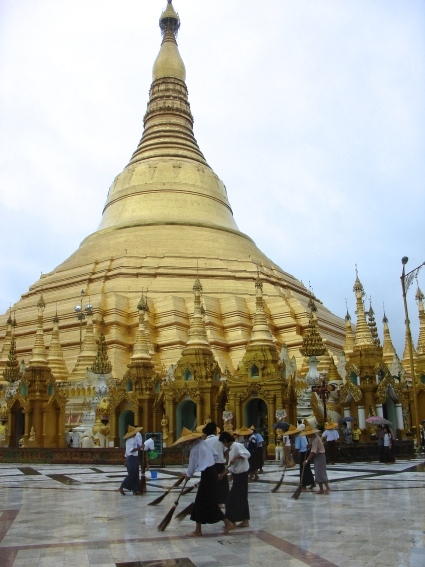
A private charter flight from Kalemyo delivered us back to Yangon, still commonly referred to asRangoon, a city of faded colonial glory and the breathtaking Shwedagon pagoda with its shimmering gold roofs. A highlight was high tea at The Strand, a gorgeous old hotel once operated by the same folk who owned Raffles in Singapore.

Travelling to Myanmar inevitably raises questions about whether you should or shouldn’t go – the Lonely Planet guide gives useful summaries of the arguments for and against. What is clear once you get there is that the locals are very pleased to have you in their country. We were reminded by several brave souls who broached the subject of politics that “the only thing we (the Burmese) can do is tell you people to spread the word.”

One way tourists can help is to make direct donations. Pandaw is involved in several community projects and during our visit, everyone pitched in to contribute money to a school and hospital.

Despite the fact that most people in Myanmar live a hand to mouth existence, they are dignified, stoic and among the warmest and most welcoming people on earth. They are also devoutly Buddhist.

At the desolate National Museum in Yangon, where there are more staff than visitors, our guide points out the Lion Throne that was once in the palace at Mandalay. At the foot of it is a goddess looking over an elephant and a tiger in combat as they vie to control the world.

“She (the goddess) brought peace to them and it’s now a message that if you pray to this goddess you can have peace in the world,” says our guide, with resignation or hope, I’m not sure which.

Fact file:

Pandaw Cruises offers 13-day cruises on the Irrawaddy and Chindwin Rivers in Myanmar (Burma) and 8-day cruises on the Mekong River in Vietnam and Cambodia. There is also a 3-day Bagan to Mandalaycruise. The cruises are operated by the Irrawaddy Flotilla Company, represented in Canberra by Active Travel (phone +61-2-6249 6122; www.activetravel.com.au). The Chindwin River cruise is priced from $4945 per person on a twin-share basis. Prices are from Rangoon to Rangoon; international airfares are extra. Departures are on September 1 (upstream) and September 11 (downstream).

© Christine Salins

{ 0 comments }