Eco-Tourism

Zaandam, those lizards are big …

by Christine Salins on January 5, 2012

20120122-000106.jpg
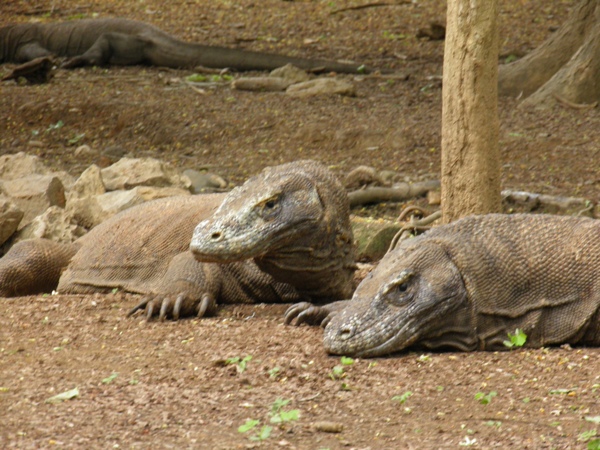
It’s fitting that my close encounter with the Komodo dragon has taken place as we herald in the Year of the Dragon.

As you will have read from my earlier blog posts, we’ve been sailing from Sydney to Singapore on board the Holland America Line cruise ship, Zaandam.

One of the motivating factors for me in undertaking this cruise was the opportunity to see the Komodo dragon in its natural habitat.

It’s been a long-held dream of mine to go to Komodo but this remote island in Indonesia isn’t the easiest place in the world to get to. When I saw that it was one of the ports of call for the Zaandam, the cruise had my name written all over it.

Why the fascination with this creature, which is really just an enormous monitor lizard? Well, for starters, it’s the largest lizard on the planet, all 70 kilos or so of it. Some have been known to grow up to 3 metres long.

It’s an impressive looking animal, being a relic of the dinosaur era with a ferocious looking tongue that it spits out constantly. It emits a toxic venom that can kill an adult (and it’s a cannibalistic animal that eats its own young). Needless to say, the young ones spend a lot of time up in the trees to avoid being eaten.

The Komodo dragon feeds mainly on water buffalo, deer and other prey – we saw a couple of deer sitting nonchalantly in the sun, oblivious to the fate that would most likely await them.

It will generally steer clear of humans but let’s not forget it is a wild animal, so there’s no guarantee. I can’t begin to tell you what a rush of adrenalin it was to see this mammoth animal rushing up the path toward our tour group, before it was herded out of the way by a ranger armed only with a long forked stick.

“Get off the path,” roared the guides before we were just as suddenly ordered to get back on the path as the animal decided on a detour.

Interestingly, we were warned in a letter to all passengers that we should not go ashore at Komodo if we had open wounds or cuts, or if female guests were experiencing their menstrual cycle. This is because the animal has a keen sense of smell that can detect blood for several miles.

According to our affable guide, Yuyen, there are about 1200 Komodo dragons still in existence on the Indonesian islands, though Wikipedia puts the number between 4000 and 5000. In Yuyen’s experience, you’re actually more likely to see them on neighbouring Rinca Island.

But it’s to Komodo Island we’ve come and so here we are, getting up close and personal with not just one, but six, of these creatures in the wild.

Later in the day, we visited Kampung Komodo, the only village on the island, populated by just one or two thousand people who lead a pretty well subsistence lifestyle, living in ramshackle houses on stilts near the water’s edge (or in many cases with the water flowing right in underneath, so that their fishing boats can be easily launched).

They survive almost entirely on fishing and life is extremely tough for them, especially since the declaration of Komodo National Park, as it has limited the resources they can gather. So as with many communities around the world that are similarly challenged, tourism provides a much-needed source of revenue.

20120122-000459.jpg

{ 0 comments }

Sapphire Coast

by Christine Salins on November 27, 2009

Published in Senior Traveller.

Walking along the edge of picturesque Bunga lagoon on the NSW Sapphire Coast, Sue Swensson stops to pick up a fossil of club moss that is 360 million years old.

She still can’t believe her luck in finding such a peaceful spot in which to set up her fledgling tour business.

“What I love about coming down here is, every time it’s different,” says Sue, pointing out a pretty violet-coloured snail and some quaintly named “by-the-wind sailors”, a bright blue disc-shaped creature that looks like a blue bottle without the sting.

Sue was so determined to establish a business embracing her love of the environment that she went off to university and graduated with a degree in environmental studies at the age of 47. She also undertook a travel agent’s course, but the next step was to find a place for her and her geologist husband Carl to put down roots.

“We had a dream. We had this list of what we wanted – it had to be east coast, estuary, mountains behind. We’d lived everywhere fromCairnstoKalgoorlieso we knew what we didn’t want.”

Carl’s job had taken the Swenssons all over the country, and it was in Kalgoorlie that Melbourne-born Sue fell in love with the bush. A keen bushwalker, bird watcher and photographer, she worked as a cartographer before deciding she wanted to go into nature-based tourism.

Narrowing their search down to the area between Tathra and Bermagui, the Swenssons found a beautiful unspoilt property at Murrah, where the only sound is that of the bellbirds in the trees.MimosaRocksNational Park, with its wetlands, cliffs, lagoons and nearly 20km of stunning coastline, is almost at their back door.

SapphireCoastEcotours, the company set up by the Swenssons, offers half- and one-day interpretive tours in the park, and as the only tour company licensed to operate within the park, can take people to places that would be difficult to find independently.

Sue takes a maximum of four people on the tours and can tailor-make them to suit people with interests in bird watching, flora and fauna, aboriginal culture, painting, drawing and bushwalking.

The full-day tours include a gourmet picnic prepared by local chef Georgina Adamson, who specializes in using local produce. Packages with transport, accommodation and meals can be arranged for those who wish to spend a few days in the region discovering its pristine beaches, thriving arts community and other attractions.

Both half- and full-day tours generally take in Goalen Head, a spectacular headland where visitors come face-to-face with aboriginal history. Aboriginal middens are located here and elsewhere in the park, which also has many burial and ceremonial sites.

Sue calls on the local indigenous community to help explain the significance of the coast in local aboriginal history. Eric, from the community-owned Umbarra Aboriginal Cultural Centre, stands atop Goalen Head and tells us all about the Yuin people who inhabited the area, their bush tucker and their spiritual links to the land.

Aboriginal people have occupied the area for at least 6000 years and possibly as many as 25,000 years. Pointing to the shells scattered around the midden, Eric says his ancestors were careful to preserve any species they ate.

“Each midden has different shells. They went to one area for three or four months then they would move on to another place, and the shells they ate in this spot, they didn’t eat at the next spot.”

The Aborigines took their signs from nature. “When the yellow wattle was out, there was bream and salmon travelling the beaches. There was a little white flowering tree, and when it was in flower, they knew the lobsters would be out eating the weeds and not in their nests.”

From October to April, whales can often be seen breaching in the ocean. “A couple of years ago I counted 54 going past here,” says Eric.

Behind us, the landscape is dominated by Mt Dromadery – Gulaga or “Big Dromadery” to Eric’s people. In their creation story, Gulaga the mother gave birth to two sons, Baranguba and Najanuka, in a violent volcanic eruption. Baranguba, the oldest, wanted to move out to sea but when Najanuga wanted to move away too, the mother wanted to keep him close by. Baranguba is today’sMontagueIsland, while Najanuga was named “Little Dromadery” by European settlers.

As well as her tours, Sue contributes to the community in other positive ways. She is using her skills as a cartographer to help with the Montreal Goldfields project, which involves capping some old mining shafts near Bermagui so that people can safely visit them.

She is also a volunteer for the Shore Bird Recovery team, run by the National Parks & Wildlife Service. She points out a spot where she found three eggs of the hooded plover, a bird so endangered that there are thought to be only 50 breeding pairs left in NSW.

Her enthusiasm is infectious, and she delights in sharing her new home with people seeking a connection with the environment.

“We’re often doing things like bird-watching and I think people love the intimacy and immediacy of it. If there’s too many people, it’s difficult to have that,” she says. “I try to paint a picture and involve people.”

Fact file:

Where is it? Mimosa Rocks National Parkis 420km south ofSydney. Access to the park is via the gravel roads which lead off from the Bermagui-Tathra Road.

Where to stay? Mimosa Cottages (+61-2-6494 0163) has two cottages in a picturesque vineyard and rainforest setting. Bimbimbi House (+61-2-6493 4456) has fabulous views of  the Bermagui River through majestic spotted gums.

Bookings? Sapphire Coast Ecotours: +61 (2) 6494 0283 or www.sapphirecoastecotours.com.au

Sapphire Coast Tourism: +61-1800 633 012 or www.sapphirecoast.com.au

© Christine Salins

{ 0 comments }